These are the solutions to the WASSCE 2025 Core Mathematics Paper 1. The questions without the solutions may be found at WASSCE 2025 Core Maths Paper 1.
1. Solve: \( \displaystyle \frac{\log_3{(2x – 1)}}{\log_3{243}} = \frac{2}{5} \).
A. x = 5
B. x = 4
C. x = 3
D. x = 6
Answer: A
Solution
Noticing that 243 = 35, we may write the equation as
$$ \frac{\log_3{(2x – 1)}}{\log_3{3^5}} = \frac{2}{5} $$
Applying the power law of logarithms to the denominator on the left hand side, we get
$$ \frac{\log_3{(2x – 1)}}{\log_3{3^5}} = \frac{\log_3{(2x – 1)}}{5 \log_3{3}} = \frac{\log_3{(2x – 1)}}{5} = \frac{2}{5} $$
Multiplying both sides by 5 gives
$$ \log_3{(2x – 1)} = 2 $$
By the definition of the logarithm, we have 2x – 1 = 32 = 9, which simplifies to x = 5.
2. A man cycles a distance of (3a) km at V km/h and then walks a distance of a km at (V – 7) km/h. Find the total number of hours he spent travelling.
A. \( \displaystyle \frac{4a}{2V – 7} \)
B. \( \displaystyle \frac{V}{3a} + \frac{V – 7}{a} \)
C. \( \displaystyle \frac{3a}{V} + \frac{a}{V – 7} \)
D. \( \displaystyle \frac{2V – 7}{4a} \)
Answer: C
Solution
The total number of hours the man spent traveling is the number of hours he spent cycling plus the number of hours he spent walking.
The number of hours he spent cycling is the distance he cycled in km divided by the speed at which he cycled in km/h. This quantity is
$$ \frac{3a}{V} $$
Similarly, the number of hours he spent walking is
$$ \frac{a}{V – 7} $$
Hence, the total number of hours he spent traveling is
$$ \frac{3a}{V} + \frac{a}{V – 7} $$
3. The first 4 terms of an Arithmetic Progression (A. P.) are 8, x, y and 17. Find the value of x + y.
A. 31
B. 25
C. 20
D. 40
Answer: B
Solution
Method 1
One way to tackle this problem is to note that for an arithmetic progression, consecutive terms differ by the same amount. That means the difference between the first and second terms is the same as the difference between the second and third terms, which is the same as the difference between the third and fourth terms, and so on.
Thus, if we know that the first term is 8 and the fourth term is 17, the difference between them, 17 – 8 = 9, must be divided equally among the gaps between these points on a number line as shown in the figure below.
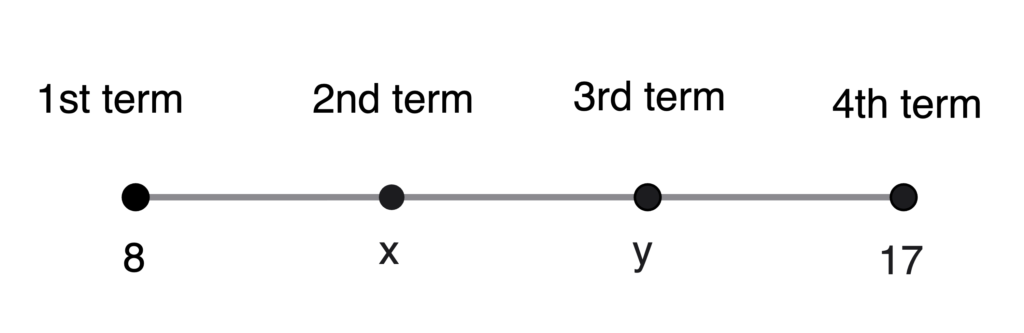
If the three gaps between 8 and 17 must be of the same length, then each one must have a length of (17 – 8)/3 = 9/3 = 3. Thus, x = 8 + 3 = 11.
Similarly, y = x + 3, meaning y = 11 + 3 = 14.
Thus, x + y = 11 + 14 = 25.
Method 2
The solution above is essentially a geometric interpretation of the algebraic approach we could have taken to the problem.
If we recall that the nth term of an arithmetic progression is a + (n – 1)d where a is the first term and d is the common difference, then we can rewrite the problem as follows:
Given a = 8 and a + 3d = 17, find (a + d) + (a + 2d).
(a + d) + (a + 2d) = 2a + 3d. This is the same as a + (a + 3d). Since we know a + 3d = 17, we add a to it to get (a + 3d) + a = 17 + 8 = 25.
Method 3
Yet another approach to this problem is to use the idea, often attributed to Gauss, that in an arithmetic progression, the sum of the first and last terms is equal to the sum of the second and last but one terms, which is equal to the sum of the third and last but two terms, and so on.
Thus, in this specific case, the sum of the first and last terms, 8 + 17, must be the same as the sum of the second and last but one terms, x + y.
That is, x + y = 8 + 17 = 25.
Which method is your favorite?
4. A town P is due south of town Q and town R is on a bearing of \( 125^{\circ} \) from Q. If town R is 20 km due east of P, find |PQ|.
A. 14 km
B. 15 km
C. 20 km
D. 12 km
Answer: A
Solution
From the statement of the question, we have the sketch below. Town P being due south of Town Q puts it directly below it as shown in the sketch. Town R being on a bearing of 125 from Q puts it somewhere close to the southeast of Q. Finally, if point R is 20 km due east of P, then it is to the right of it as shown in the diagram, and angle QPR is a right angle.
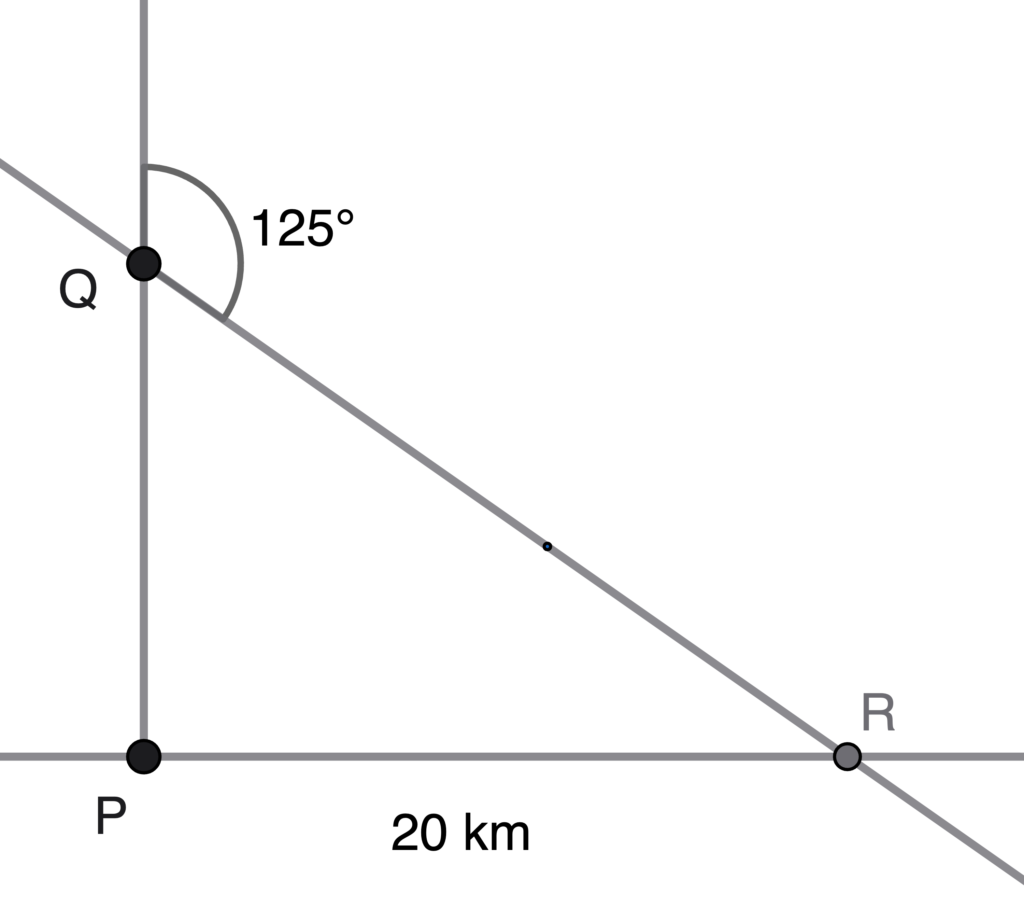
To find the length of segment PQ, we can use the fact that the tangent of angle PQR is the ratio
$$ \frac{|PR|}{|PQ|} $$
since PR is the side of the right triangle opposite angle PQR and PQ is the side adjacent to it.
The size of angle PQR is 180 – 125 = 55 since it is supplementary to the 125 angle.
Hence, we have
$$ \begin{align} \tan \angle PQR &= \frac{|PR|}{|PQ|} \\ \implies \tan 55^\circ &= \frac{20}{|PQ|} \end{align} $$
Hence,
$$ |PQ| = \frac{20}{\tan 55^\circ} $$,
which evaluates to 14.0041507642, which is about 14 km.
5. Factorize: \( 5p^2 + 4pq – 15pr – 12qr \).
A. (p + 3r)(5p + 4q)
B. (p + 3r)(5p – 4q)
C. (p – 3r)(5p + 4q)
D. (p – 3r)(5p – 4q)
Answer: C
Solution
We may group the first two terms and the last two terms together and try to factorize each pair to see what we get.
$$ \begin{align} 5p^2 + 4pq – 15pr – 12qr &= (5p^2 + 4pq) – (15pr – 12qr) \\ &= p(5p + 4q) – 3r(5p + 4q) \end{align} $$
Since both terms have (5p + 4q) in common, we factorize that out to get
$$ p(5p + 4q) – 3r(5p + 4q) = (p – 3r)(5p + 4q) $$
Leave a Reply